Choosing between a tank and a tankless water heater can make a significant difference in your home’s hot water supply, energy bills, and long-term maintenance costs. While traditional tank water heaters store hot water for later use, tankless models heat water on demand without maintaining a large reservoir.
So, which option is better for your home in 2026? The answer depends on your household size, hot water demand, budget, available energy sources, and installation requirements. Both systems offer advantages, but neither is the perfect solution for every homeowner.
In this guide, we compare tank vs tankless water heaters, including upfront costs, energy efficiency, hot water capacity, lifespan, installation, and maintenance. By the end, you will have a clearer idea of which system best fits your needs.
Tank vs Tankless Water Heater: Quick Comparison
Before looking at the details, here is a quick overview of the main differences between these two types of water heaters.
| Feature | Tank Water Heater | Tankless Water Heater |
|---|---|---|
| How it works | Stores and heats water in a tank | Heats water as it flows through the unit |
| Upfront cost | Generally lower | Generally higher |
| Energy efficiency | Can lose heat while storing water | Reduces standby heat losses |
| Hot water supply | Limited by stored capacity and recovery | Continuous while demand stays within capacity |
| Installation | Often simpler as a like-for-like replacement | May require electrical, gas, or venting upgrades |
| Space requirements | Needs room for a storage tank | Usually more compact |
| Maintenance | May require sediment management and anode inspection | May require periodic descaling |
| Expected lifespan | Often around 8–15 years | Often around 15–20 years |
These lifespan figures are general estimates, not guarantees. Actual service life depends on water quality, maintenance, usage, installation, and the manufacturer’s specifications.
1. What Is a Tank Water Heater?
A tank water heater, also called a storage water heater, heats water and keeps it inside an insulated tank until it is needed. Most residential models use electricity or natural gas, although other fuel options are available.
When someone opens a hot water tap, heated water leaves the tank and cold water enters to replace it. The heater then works to maintain the temperature and replenish the hot water supply.
Advantages of Tank Water Heaters
- Lower initial cost: Conventional storage models are often less expensive to purchase than tankless systems.
- Simple replacement: Installing a similar model can be straightforward when existing connections are compatible.
- Stored hot water: The tank provides a reserve for periods of high demand.
- Wide availability: Many plumbers are familiar with installing and servicing conventional models.
- Predictable operation: The system stores a known volume of hot water, although the usable supply also depends on recovery rate.
Disadvantages of Tank Water Heaters
The biggest limitation is the finite amount of hot water available in the tank. If several people take long showers consecutively, the supply may run low before the water reheats.
Storage tanks also experience standby heat losses because they must maintain the water temperature between uses. Insulation helps reduce these losses, but it cannot eliminate them completely.
Tank water heaters occupy more floor or storage space and may eventually develop corrosion or tank leaks. If you notice unusual sounds coming from your unit, read our guide to water heater making noise to understand common causes and possible solutions.
2. What Is a Tankless Water Heater?
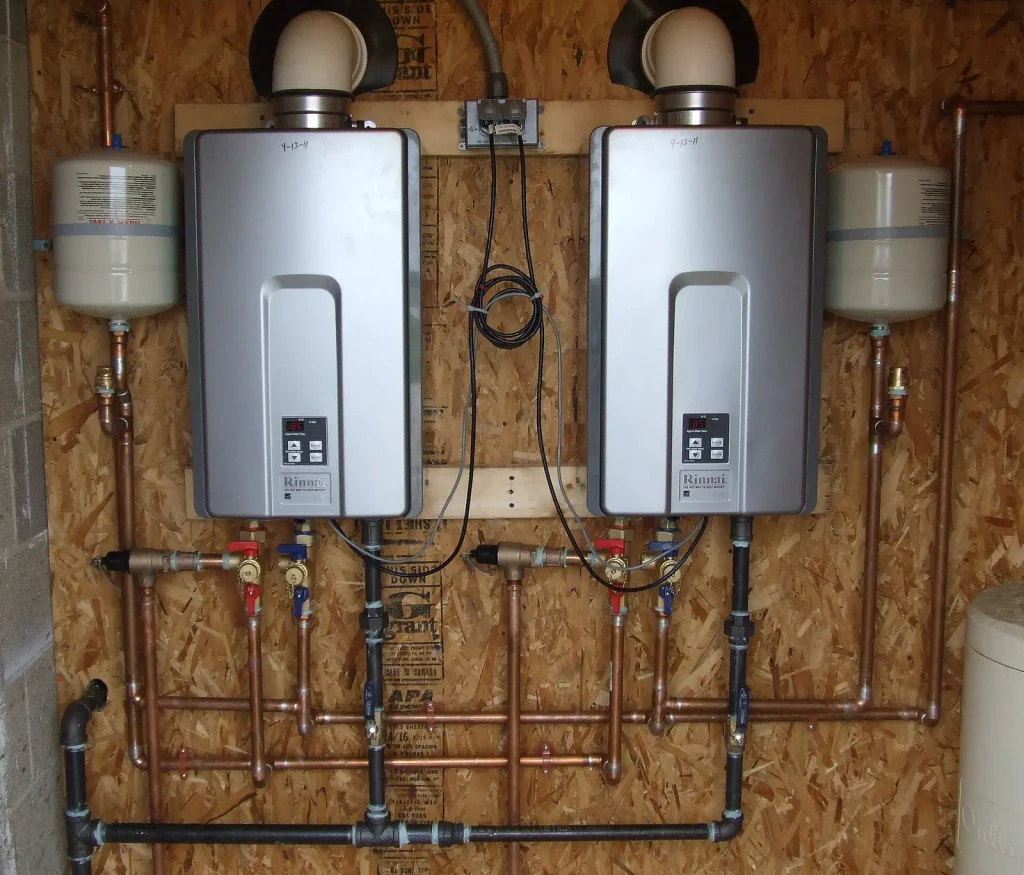
A tankless water heater, also known as an on-demand water heater, heats water as it flows through the unit. Instead of keeping a large volume of water hot all day, the system activates when hot water is requested.
Gas tankless models use a burner, while electric versions use heating elements. The unit transfers heat to the passing water and delivers it to the fixture.
Advantages of Tankless Water Heaters
- Reduced standby losses: The system does not continuously maintain a large tank of hot water.
- Space savings: Compact units can free up valuable floor space.
- Extended hot water availability: A properly sized model can continue heating water while demand remains within its rated capacity.
- Potentially longer service life: Many tankless models can last longer than conventional storage heaters with proper maintenance.
- Flexible installation locations: Some models can be installed on a wall, subject to manufacturer requirements.
Disadvantages of Tankless Water Heaters
Tankless systems usually cost more upfront, and converting from a tank model can involve significant installation work.
They also have maximum flow rates. If several showers and appliances operate simultaneously, the unit may not deliver enough hot water at the required temperature.
Some models take a short time to activate and deliver hot water. The wait at a distant faucet may still be affected by the length of the plumbing pipes.
Maintenance is another consideration. In areas with hard water, mineral deposits can accumulate inside the heat exchanger and may require periodic descaling.
3. Tank vs Tankless: Which Is More Energy-Efficient?
Energy efficiency is one of the main reasons homeowners consider switching to a tankless water heater.
A conventional storage model can lose heat while keeping stored water hot. A tankless system avoids most of these standby losses because it heats water when needed. This can improve efficiency, particularly in households with lower or intermittent hot water demand.
However, the actual difference depends on the specific models, fuel type, usage patterns, and local energy prices. A high-efficiency storage heater may perform better than an inefficient tankless model.
When comparing products in the United States, check the Uniform Energy Factor (UEF) and look for applicable ENERGY STAR water heater efficiency criteria.
For additional guidance, the U.S. Department of Energy’s consumer water heater resources explain the main residential technologies and their characteristics.
Remember that the most energy-efficient model is not always the cheapest to operate in every location. Compare the unit’s efficiency rating with your actual electricity or gas rates before making a decision.
4. Which Water Heater Is Cheaper to Buy and Install?
If your main priority is minimizing the initial investment, a conventional tank water heater is often the more affordable option.
Tank models are widely available, and replacing an existing unit with a compatible model may require fewer modifications. However, the final price still depends on capacity, fuel type, labor, and local installation requirements.
Tankless water heaters generally have a higher purchase price. Installation can also become more expensive if the home needs larger gas piping, upgraded electrical service, new venting, or plumbing modifications.
For a fair comparison, request itemized quotes for both options. Include equipment, installation, permits, removal of the old unit, and any required upgrades.
Do not compare purchase prices alone. A tankless model may recover part of its additional cost through lower energy consumption or a longer service life, but the result depends on household usage and installation expenses.
5. Which System Provides More Hot Water?
The answer depends on whether you prioritize stored capacity or continuous heating.
A tank water heater supplies hot water from its reservoir. Once that reserve is depleted, the heater needs time to recover. A larger tank or a model with a higher first-hour rating can help households with concentrated periods of demand.
A tankless system heats water as needed and can provide an extended supply without waiting for a tank to refill. However, it cannot exceed its rated flow capacity.
For example, a household running two showers, a dishwasher, and a washing machine at the same time may exceed the output of a small tankless unit.
Before purchasing a tankless model, calculate the combined flow rate of the fixtures likely to operate simultaneously and the temperature rise required. For storage models, compare tank capacity and first-hour rating.
Proper sizing is essential for both technologies. An undersized tankless unit can struggle during peak demand, while an undersized tank may run out of hot water.
6. Installation Requirements: Tank vs Tankless
Installation requirements can determine which system makes the most sense for your home.
Tank Water Heater Installation
Storage heaters require enough space for the tank, access to plumbing and energy connections, and appropriate safety provisions. The filled tank can be heavy, so the floor or supporting structure must be suitable.
Gas models need compliant combustion air and exhaust venting. Electric models need an appropriate electrical circuit. Drainage and leak protection should also be considered according to the installation conditions and local codes.
Tankless Water Heater Installation
Tankless models generally need less physical space but may require more demanding utility connections.
Gas units must have sufficient gas supply and suitable venting. Electric models may require substantial electrical capacity, depending on their output and design.
Ask a qualified installer to evaluate your home’s connections before choosing a model. A system that appears cheaper online may become considerably more expensive once installation upgrades are included.
7. Maintenance and Lifespan
Both tank and tankless water heaters need maintenance to remain safe and operate efficiently.
Tank Water Heater Maintenance
Depending on the model and water conditions, maintenance may include inspecting the anode rod, managing sediment buildup, checking connections, and verifying the operation of safety components.
Corrosion and leaks can eventually make replacement necessary. If you discover moisture around the upper connections, read our article on water heater leaking from the top to learn about possible causes and when professional inspection is needed.
Tankless Water Heater Maintenance
Tankless systems may need periodic descaling, especially in areas with hard water. Filters, air intakes, and other serviceable components should be checked according to the manufacturer’s maintenance schedule.
In general, tankless models often have a longer expected service life, but poor maintenance or unsuitable water conditions can shorten it.
Always follow the manufacturer’s instructions and use a qualified professional for gas, electrical, combustion, or internal component work.
8. Tank vs Tankless Water Heater: Which One Should You Buy?
The best choice depends on your budget, hot water usage, available space, and long-term plans.
Choose a Tank Water Heater If:
- You want a lower upfront purchase and installation cost.
- Your existing tank can be replaced without major modifications.
- Your household’s hot water demand fits the available storage capacity.
- You prefer a familiar system with widely available service options.
- You have enough space for a storage tank.
Choose a Tankless Water Heater If:
- You want to reduce standby heat losses.
- You have limited space for a conventional tank.
- Your household would benefit from an extended supply of hot water.
- You are prepared for potentially higher installation costs.
- Your gas or electrical service can support the selected model.
If you are replacing an aging heater, consider the full cost of ownership rather than choosing based on technology alone. Your current plumbing, local energy prices, and expected hot water demand can make a significant difference.
Frequently Asked Questions
Is a tankless water heater better than a tank water heater?
Neither is universally better. Tankless models save space and reduce standby heat losses, while tank heaters often have lower upfront costs and provide a reserve of stored hot water. The best option depends on your household’s needs and installation conditions.
Do tankless water heaters really save money?
They can reduce energy consumption compared with some storage models, but savings depend on efficiency, hot water demand, fuel prices, and installation costs. Calculate the expected long-term savings before paying more upfront.
How long do tank and tankless water heaters last?
Conventional tank heaters often last around 8–15 years, while tankless models may last around 15–20 years. These are general estimates, and actual service life varies with maintenance, water quality, and operating conditions.
Can a tankless water heater run multiple showers at once?
Yes, if its output is sufficient for the combined flow rate and required temperature rise. A unit that is too small may struggle to maintain the desired temperature when multiple fixtures operate simultaneously.
Is it worth replacing a tank water heater with a tankless model?
It may be worthwhile if you want to save space, reduce standby losses, or benefit from a longer potential service life. However, a conversion can involve expensive utility and venting upgrades. Compare itemized installation quotes and projected energy costs before deciding.
Final Verdict: Tank vs Tankless Water Heater
A tank water heater is often the practical choice for homeowners who want a lower initial investment and a straightforward replacement. A tankless model may be better for those who value space savings, reduced standby losses, and an extended supply of hot water within the unit’s capacity.
Before buying, compare efficiency ratings, calculate your household’s peak demand, review installation requirements, and consider maintenance and warranty coverage.
The right water heater is not necessarily the most expensive or most advanced model. It is the one that reliably meets your hot water needs while offering the best overall value for your home.
This article provides general educational information. Follow the manufacturer’s instructions and applicable local plumbing, electrical, gas, and building requirements.