A regular water heater maintenance checklist can help you spot small problems before they turn into expensive repairs. Whether you have a traditional storage tank, a gas tankless unit, an electric tankless heater, or a hybrid heat pump water heater, a few routine checks can help protect your equipment and keep hot water available when you need it.
But not every task belongs on a monthly schedule. Some checks take only a minute, while flushing a tank, inspecting an anode rod, or servicing a temperature and pressure relief valve requires more care. The correct schedule also depends on your water quality and the manufacturer’s instructions.
This guide organizes water heater maintenance by frequency: monthly, every six months, annually, and every three to five years. Use it as a planning tool, then confirm the exact procedures and intervals in your unit’s owner’s manual.
Water Heater Maintenance Checklist at a Glance
| Frequency | Maintenance task | Who can usually do it? |
|---|---|---|
| Monthly | Look for leaks, corrosion, unusual noises, and changes in hot water performance. | Homeowner |
| Monthly | Check visible pipes, fittings, and the floor around the heater for moisture. | Homeowner |
| Every 6 months | Review water quality symptoms, check accessible connections, and inspect the surrounding area. | Homeowner; professional if a problem is found |
| As specified by the manufacturer | Flush a storage tank to remove sediment. | Experienced homeowner or plumber |
| Annually, or as specified | Review the temperature setting, inspect the venting of gas units, and check the T&P valve according to the manual. | Homeowner for visual checks; qualified professional for repairs |
| Annually for many heat pump models | Clean the air filter and inspect or clean the condensate drain as instructed. | Homeowner if the manual permits |
| Every 3–5 years as an initial planning interval | Have the anode rod inspected if the manufacturer or water conditions warrant it. | Plumber or experienced DIYer if permitted by the manual |
| Every 3–5 years and as needed | Review the maintenance history, recurring scale, corrosion, and any professional service recommendations. | Homeowner and qualified service professional |
Important: This is a general planning schedule, not a universal service requirement. Some manufacturers recommend more frequent flushing, anode inspection, or filter cleaning. Follow your model’s instructions, especially for safety devices, electrical isolation, gas appliances, and descaling.
1. Monthly Water Heater Maintenance Checklist
Most monthly maintenance involves looking and listening rather than opening the unit. These quick checks can help you identify a leak, a developing performance problem, or a change that deserves professional attention.
Check for water leaks
- Look around the base of a tank water heater for standing water or unexplained dampness.
- Inspect visible hot- and cold-water connections for drips, mineral deposits, or corrosion.
- Check the area around the drain valve and the temperature and pressure relief valve discharge pipe without operating either component.
- For heat pump water heaters, check for water around the condensate drain and drain pan.
A small amount of water may come from a condensate drain on a heat pump model, but unexplained pooling should not be ignored. Water leaking from the tank body can indicate a serious problem. Read our guide to water heater leaks from the top to learn how to identify possible sources.
Listen for unusual sounds
Pay attention to new popping, rumbling, banging, or hissing sounds. Some operating noises are normal, but a noticeable change can indicate sediment, scale, pressure problems, or a component that needs inspection.
Do not open a gas burner compartment or remove electrical covers to investigate sounds. If you hear a gas leak, smell gas, or suspect carbon monoxide, leave the area and follow the appropriate emergency procedures.
For more help identifying common noises, see Water Heater Making Noise.

Check hot water performance
Notice whether hot water takes longer to arrive, runs out sooner than usual, fluctuates in temperature, or has an unusual appearance or odor. A sudden change can be caused by several issues, including sediment, a failed heating element, a thermostat problem, scale, or a change in household demand.
Record the symptom and when it occurs. This information can help a technician diagnose the issue without unnecessary trial and error.
Keep the area around the heater clear
Keep the unit accessible for inspection and service. Do not store flammable materials near gas-fired equipment, block combustion air openings, or obstruct the intake and exhaust of a heat pump water heater. Follow the clearances and storage restrictions in the manufacturer’s manual.
2. Every Six Months: Review Connections and Water Quality
Every six months, repeat the monthly visual checks and take a closer look at the installation area. This is also a good time to decide whether the unit needs flushing, descaling, or a professional inspection based on its operating history.
- Look for corrosion, mineral buildup, or staining around accessible connections.
- Check whether the drain pan or condensate drain has standing water.
- Review whether the heater has developed longer recovery times or reduced hot water output.
- Check the manufacturer’s maintenance schedule for flushing or descaling intervals.
- Consider whether hard water or softened water may affect the anode rod and scale buildup.
Do not tighten pressurized fittings or adjust gas connections simply because they look old. If a connection is leaking or corroded, have it assessed and repaired safely.
3. Flush a Tank Water Heater When Required
Sediment can accumulate at the bottom of a conventional storage water heater. Depending on the water supply and usage, mineral deposits may contribute to noise, reduce usable capacity, or interfere with heat transfer.
Flushing can help remove loose sediment, but the required frequency depends on the model and local water conditions. Some manufacturers recommend periodic flushing; others provide specific instructions based on water quality and usage.
General flushing considerations
- Read the owner’s manual before starting and confirm that the drain valve and discharge route can be used safely.
- Keep children and pets away from the work area. Water inside the tank may be hot enough to cause severe burns.
- Follow the manufacturer’s shutdown procedure for the fuel or power source before draining.
- Use a hose and drain arrangement rated for the water temperature and flow, and route the discharge to a suitable location.
- Follow the unit’s approved flushing and refill procedure. Make sure the tank is completely full and air has been purged before restoring power to an electric resistance heater.
Do not force a stuck drain valve or proceed if the valve, hose connection, or discharge route appears unsafe. Older valves can leak or fail to close after being operated. A plumber can flush the tank if you are uncertain about the procedure.
For detailed instructions, read How to Flush a Water Heater: Step-by-Step Guide.
4. Annual Water Heater Maintenance
Once a year, review the important safety and performance components. Some checks can be done visually, while testing, disassembly, and repairs may require a qualified professional.
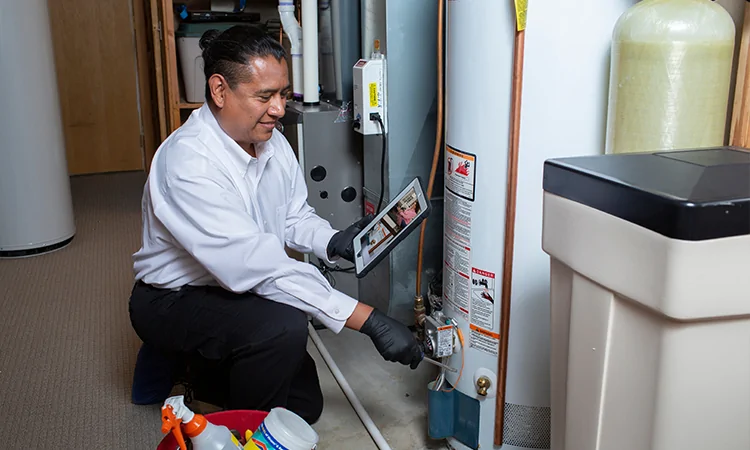
Review the temperature setting
Check the thermostat setting and compare it with the manufacturer’s recommendations and your household’s needs. Many households use a setting around 120°F to reduce scald risk and energy use, but the appropriate setting depends on the system, household health considerations, and any applicable requirements for controlling Legionella.
Do not change the setting without considering the risk of scalding, the need for adequate hot water storage temperature, and whether a thermostatic mixing valve is installed. Learn more in What Temperature Should You Set Your Water Heater? Safety vs Savings.
Inspect gas water heater venting
For gas-fired units, visually inspect accessible venting for obvious damage, disconnections, corrosion, or obstructions. Do not dismantle the vent or burner assembly unless you are qualified and the manufacturer permits the procedure.
Combustion and exhaust problems can be dangerous. A qualified technician should investigate damaged venting, unusual combustion behavior, soot, repeated shutdowns, or other signs of improper operation.
Review the temperature and pressure relief valve
The temperature and pressure (T&P) relief valve is a critical safety device on a storage water heater. It protects the tank against excessive temperature or pressure. Check the owner’s manual for the recommended inspection and testing schedule.
Manual testing can release very hot water and may cause an older valve to continue dripping afterward. Before any test, make sure the discharge pipe terminates safely and nobody can be scalded. If you are unsure how to test it, arrange professional service instead.
Never cap, plug, or block the relief valve or its discharge pipe. If the valve leaks continuously, appears damaged, or fails to close properly after a test, stop using the heater if it is safe to do so and contact a qualified plumber promptly.
Read our dedicated guide: How to Test and Replace a Water Heater T&P Relief Valve.
Clean the heat pump water heater air filter
Heat pump water heaters draw in surrounding air to extract heat. A dirty filter or obstructed air intake can reduce airflow and affect performance.
ENERGY STAR installation guidance recommends cleaning air filters on many models every 6 to 12 months, with more frequent cleaning in dusty locations. Follow the interval and cleaning method specified for your unit.
- Turn off the unit if the manufacturer’s instructions require it before filter service.
- Remove and clean the filter only as directed in the manual.
- Check that the air intake and outlet are not blocked.
- Inspect the condensate drain for signs of blockage and confirm that water drains as intended.
ENERGY STAR also recommends checking heat pump water heater condensate lines periodically and cleaning them according to the manufacturer’s instructions. See its heat pump water heater installation best practices.
5. Every Three to Five Years: Inspect the Anode Rod and Review System Condition
The anode rod is a sacrificial metal component in many storage tank water heaters. It helps protect the steel tank from corrosion by corroding in place of the tank lining. Once the rod is significantly depleted, the tank may become more vulnerable to corrosion.
There is no universal replacement interval. Water chemistry, water softening, temperature, usage, and the rod’s material all affect how quickly it wears out. Some systems need inspection sooner than three years; others may go longer.
What to do
- Check the manufacturer’s recommended inspection interval.
- Ask a plumber to inspect the rod if the heater is several years old and its condition is unknown.
- Replace the rod when its condition indicates that replacement is necessary, using a compatible part approved for the unit.
- Keep a record of the inspection and replacement date.
Removing an anode rod can involve hot water, pressure, heavy tools, and a tight fitting. It may also be difficult to remove if there is limited overhead clearance. If you do not have the correct tools or experience, use a qualified plumber.
For the detailed procedure and warning signs, see Water Heater Anode Rod: When to Replace It and How.
Review the whole system, not just the tank
After three to five years, review the heater’s maintenance history and check whether it has needed repeated repairs. Look for recurring scale, corrosion, leaks, inconsistent temperatures, or unusually high energy use. These symptoms may point to a maintenance issue, a component failure, or a system that no longer fits the household’s needs.
Age alone does not determine whether a water heater needs replacement. Compare its condition, repair history, efficiency, and replacement cost before deciding. Our guide to how long water heaters last explains common lifespan ranges and signs that replacement may be approaching.
Tankless Water Heater Maintenance Checklist
Tankless water heaters do not store a large volume of hot water, but they still require maintenance. Mineral scale can build up inside the heat exchanger, especially in areas with hard water. This can reduce performance and may trigger error codes or overheating protection.
For a gas or electric tankless unit, your checklist should include:
- Inspect accessible water connections for leaks or corrosion.
- Check the unit’s error history and note any repeated shutdowns.
- Clean inlet water filters or screens according to the manufacturer’s instructions.
- Descale or flush the heat exchanger at the interval recommended for the model and water quality.
- For gas models, inspect the approved venting system and air intake as specified in the manual.
- For condensing gas models, check the condensate drain for blockage or leakage.
Descaling procedures differ by manufacturer. Use only a cleaning solution approved for the model and follow the specified isolation, flushing, and rinsing procedure. Do not assume vinegar is suitable for every unit or every component.
For related help, read What Size Tankless Water Heater Do You Need?, Tankless Water Heater Installation Requirements, and Gas vs Electric Tankless Water Heater: Which Is Better?.
Heat Pump Water Heater Maintenance Checklist
Hybrid heat pump water heaters need many of the same checks as conventional storage tanks, plus a few additional tasks related to airflow and condensate.
- Inspect the tank, fittings, drain pan, and visible pipes for leaks.
- Clean the air filter at the interval specified by the manufacturer.
- Keep the air intake and outlet clear of dust, storage boxes, and other obstructions.
- Inspect and clean the condensate drain according to the manual.
- Review operating modes and energy use if the unit appears to rely on electric resistance more often than expected.
- Follow the storage tank’s recommended maintenance schedule for sediment, the anode rod, and the T&P relief valve.
Do not cover a heat pump water heater with an insulating blanket unless the manufacturer explicitly approves it. Blocking the air path or covering controls can impair performance or create a safety issue.
Learn more about choosing and operating these systems in our guides to the best heat pump water heaters of 2026, heat pump water heater pros and cons, heat pump water heater vs. tankless, and whether a heat pump water heater can work in a garage or cold climate.
Water Heater Maintenance Problems You Should Never Ignore
Routine maintenance can identify warning signs, but some symptoms require prompt professional attention rather than another checklist item.
- Water leaking from the tank body: The tank may be corroded and may need replacement.
- Continuous discharge from the T&P valve: This can indicate a valve problem, excessive pressure, or overheating. Never block the discharge.
- Gas smell: Leave the area and follow local emergency guidance. Do not operate electrical switches or attempt repairs.
- Carbon monoxide alarm or suspected combustion exhaust problem: Leave the building and contact emergency services or the appropriate qualified professionals.
- Repeated breaker trips or signs of overheated wiring: Stop using the equipment if safe and contact a qualified electrician or technician.
- Sudden loss of hot water or repeated error codes: Record the symptoms and consult the manufacturer’s troubleshooting guidance or a qualified technician.
How Maintenance Affects Operating Costs
Maintenance does not guarantee a lower utility bill, but it can help prevent avoidable performance problems. Scale, restricted airflow, faulty controls, or leaking hot water can waste energy or reduce the amount of useful hot water your system provides.
Keep a record of energy use, maintenance dates, and repairs. If consumption rises noticeably without a change in household habits, investigate the cause rather than assuming the heater simply needs flushing.
For more context, see How Much Does It Cost to Run a Water Heater Per Month?, How to Choose a Water Heater, and Tank vs Tankless Water Heater.
Printable Water Heater Maintenance Checklist
Use this short checklist as a reminder. The detailed procedures and intervals in your manufacturer’s manual take priority.
Monthly
- Look for leaks, dampness, corrosion, or mineral deposits.
- Listen for unusual noises.
- Check for changes in hot water temperature, flow, or recovery.
- Keep the area around the heater clear and accessible.
Every Six Months
- Repeat the visual inspection of connections and the surrounding area.
- Review water quality and any scale-related symptoms.
- Check the manual for flushing, filter cleaning, or other scheduled service.
Annually, or as Required by the Manufacturer
- Review the thermostat setting and household hot water needs.
- Inspect accessible gas venting for visible damage, if applicable.
- Follow the manufacturer’s instructions for the T&P relief valve.
- Clean the heat pump water heater filter and inspect its condensate drain if applicable.
- Flush a tank or descale a tankless unit if required by the manual and water conditions.
Every Three to Five Years, or as Condition Requires
- Arrange an anode rod inspection if appropriate for the model and water chemistry.
- Review repair history, corrosion, recurring scale, and energy use.
- Ask a qualified professional to assess any repeated problems.
Frequently Asked Questions
How often should you maintain a water heater?
Check for leaks and unusual performance monthly. Other tasks, such as flushing, descaling, anode rod inspection, and safety valve checks, should follow the manufacturer’s schedule and the home’s water conditions. Heat pump water heaters may also require periodic air filter and condensate drain maintenance.
Does a water heater need to be flushed every year?
Not every model has the same flushing interval. Sediment accumulation depends on water quality, usage, and the heater’s design. Follow the manufacturer’s instructions and ask a plumber if the drain valve is old, stuck, or leaking.
When should a water heater anode rod be replaced?
Replace it when inspection shows sufficient wear or the manufacturer recommends replacement. A three-to-five-year inspection is a useful planning prompt for some homes, but hard water, softened water, and other conditions can change the interval substantially.
Should I test the T&P relief valve myself?
Only if the manufacturer’s instructions recommend it and you can perform the procedure safely. Discharged water can be extremely hot, and an older valve may not reseal correctly. If you are uncertain, arrange professional inspection. Never block the valve or discharge line.
Do tankless water heaters need maintenance?
Yes. Tankless units may need inlet filter cleaning, heat exchanger descaling, and inspection of gas venting or condensate drainage where applicable. The frequency depends on the model and water hardness.
Do heat pump water heaters need annual maintenance?
Many models require periodic air filter cleaning and condensate drain checks, often at least annually. The exact interval can be shorter in dusty environments. Follow the manufacturer’s operating and maintenance manual.
Can regular maintenance extend a water heater’s lifespan?
Proper maintenance can help reduce avoidable wear and identify developing problems, but it cannot prevent every failure. Water chemistry, installation quality, usage, and component condition also affect lifespan.
Can I do all water heater maintenance myself?
No. Homeowners can usually perform visual inspections and some manufacturer-approved cleaning tasks. Gas repairs, electrical work, difficult drain or anode rod procedures, and repairs to safety devices may require a qualified professional. Never work on equipment if you cannot safely isolate it or follow the manual.
Final Thoughts
The best water heater maintenance plan is one you can follow consistently. Check for leaks and unusual performance every month, schedule cleaning and flushing according to the equipment manual, and pay particular attention to the anode rod, T&P relief valve, and any components specific to tankless or heat pump systems.
Keep a record of inspections, cleaning, repairs, and replacement parts. That simple habit makes it easier to recognize changes, follow the manufacturer’s service intervals, and decide when professional help is needed.
Sources and Further Reading
- U.S. Department of Energy — Technical Operations and Maintenance Guidelines
- ENERGY STAR — Heat Pump Water Heater Installation Best Practices
- ENERGY STAR — Heat Pump Water Heaters
- U.S. Department of Energy — Measure Guideline: Transitioning to a Tankless Water Heater
Disclaimer: This article is for general educational purposes only and does not replace the owner’s manual or professional advice. Water heater maintenance can involve scalding water, electrical hazards, gas appliances, and pressurized systems. Follow the manufacturer’s instructions and local codes. If you are unsure how to perform a task safely, contact a qualified plumber or technician.