A water heater making noise may have mineral deposits in the tank, scale on an electric heating element, or a plumbing problem such as water hammer. The timing matters: popping during heating is different from a single bang when a washing machine valve closes. A loud boom when a gas burner ignites needs a separate safety assessment.
Do not choose a repair from the sound alone. Note where the noise comes from, when it happens, and whether there is a leak, reduced hot water, or an error message. Those details help distinguish a maintenance issue from a fault that needs urgent attention.
This guide explains the main causes of popping, rumbling, and banging in storage-tank water heaters. It also covers related ticking and sizzling sounds, plus the different operating noises of hybrid heat-pump models. Tankless systems require their own model-specific troubleshooting.
Water Heater Making Noise: Quick Diagnosis
| Sound and timing | Possible explanation | Appropriate next step |
|---|---|---|
| Popping or rumbling during a heating cycle | Mineral deposits or sediment in the tank | Arrange a model-appropriate maintenance assessment |
| Singing, hissing, or crackling in an electric heater | Scale on an element or another component problem | Have the elements and heating performance checked |
| A sharp bang when water flow stops | Water hammer in the plumbing | Identify the triggering fixture and have the piping assessed |
| Light ticking near the inlet or outlet | Heat-trap movement or thermal expansion and contraction | Compare with normal operation and report new or worsening sounds |
| Creaking accompanied by relief-valve discharge | A possible pressure or thermal-expansion problem | Have system pressure and expansion control checked |
| A loud boom as a gas burner lights | Possible ignition or combustion fault | Stop using the heater and request qualified gas service |
| Steady fan or compressor noise on a hybrid model | Normal operation may be audible | Compare with the model’s normal sound and investigate changes |
The table narrows the questions to ask. It cannot confirm that a heater is safe to operate or identify a failed part by itself.
When a Noisy Water Heater Needs Urgent Attention
Leave the building if you smell gas or a carbon monoxide alarm sounds. Do not operate electrical switches or use a phone inside. Call emergency services or your gas utility from a safe location outside. See PSE&G’s gas-leak safety instructions for an example of utility guidance.
Also stop troubleshooting and seek prompt professional help if you notice:
- A loud bang or boom associated with gas ignition.
- Steam or forceful hot-water discharge.
- A visibly distorted tank or suspected overheating.
- Water reaching electrical components.
- Smoke, a burning smell, or repeated breaker trips.
- A substantial leak or rapidly worsening noise.
If there is no suspected gas leak and it is safe to do so, shut down the heater according to its instructions. Use an electric unit’s breaker only from a safe, dry position. If water is escaping, close the cold-water inlet only if the valve is safely accessible; do not force a seized valve.
Never block a temperature and pressure relief discharge pipe, defeat a safety switch, or repeatedly restart a heater to reproduce a concerning sound.
1. Popping and Rumbling From Sediment or Mineral Deposits
Mineral deposits can collect in a storage heater. During heating, water trapped around deposits can produce popping or rumbling as it heats and moves through the material. A. O. Smith identifies these noises in its mineral buildup technical bulletin.
This possibility becomes more relevant when the sound occurs during heating, the water supply is hard, and maintenance has been irregular. Those clues do not prove that sediment is the only problem.
What Can Reduce the Noise?
A technician can assess whether flushing, approved descaling, or another service is appropriate. Loose material and hardened scale are different maintenance problems; an ordinary drain-and-flush may not remove a firmly attached deposit.
Describe the pattern when booking service: for example, “a low rumble for several minutes after a shower” is more useful than “the tank sounds broken.” Also mention any recent change in hot-water availability.
Avoid adding a cleaning chemical or household acid on the assumption that every popping tank needs the same treatment. The compatible procedure depends on the heater, its materials, and the manufacturer’s instructions.
2. Scale on an Electric Heating Element
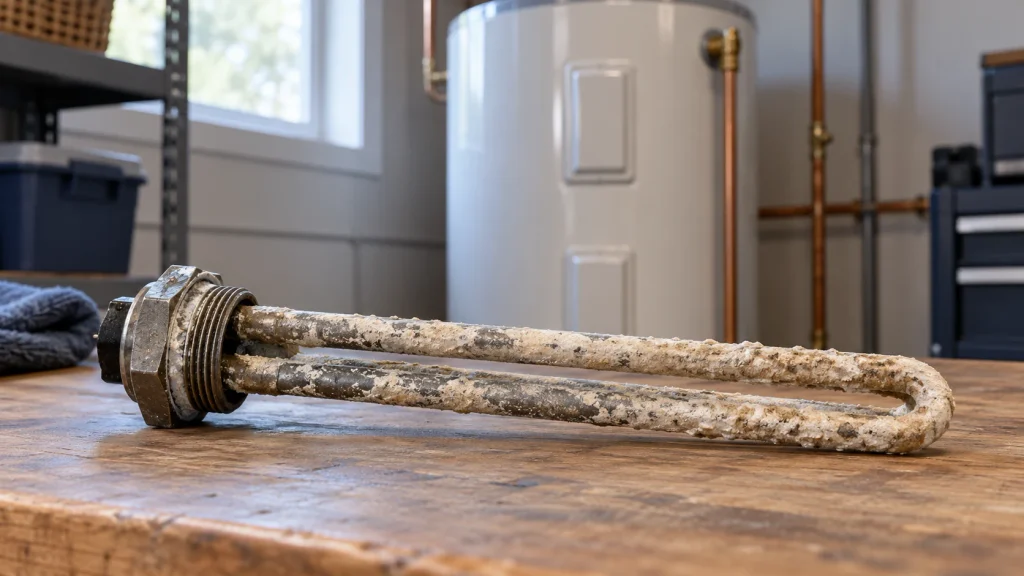
Electric heaters warm the water using immersed elements. Scale on an element can be associated with singing or hissing sounds. Bradford White discusses this separately from gas-fired tank-bottom sediment noise in its technical note on internal water heater noises.
How an Element Problem Is Addressed
An electrical and mechanical assessment can establish whether cleaning, element replacement, or another repair is justified. Noise alone does not establish that an element has failed.
Do not remove an access panel while the heater is energized. Switching a thermostat to a lower setting does not isolate the electrical supply, and electrical checks require appropriate equipment and competence.
If the heater also produces little or no hot water, read our guide to an electric water heater not heating. Treat noise and poor heating as symptoms to investigate together, rather than automatically ordering an element.
3. Banging When a Tap or Appliance Valve Closes
A sharp knock that coincides with water flow stopping can originate in the plumbing rather than inside the heater. Water hammer is a pressure surge caused by an abrupt change in flow, such as a quick-closing appliance valve.
The sound can travel along the pipes, so it may appear to come from the water heater even when a washing machine, dishwasher, or tap triggers it. A. O. Smith explains the mechanism in its water hammer bulletin.
What a Plumber May Check
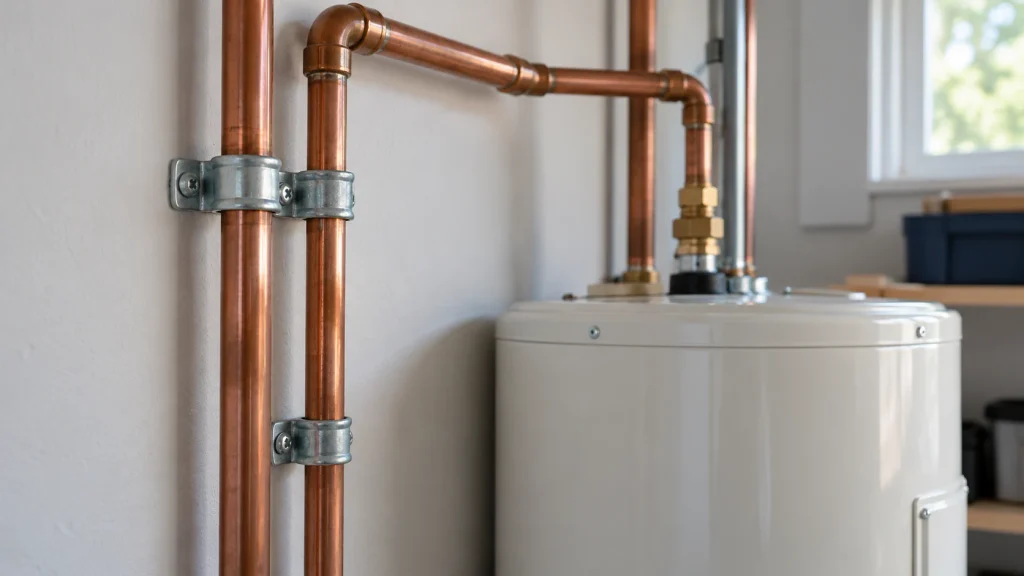
A plumber can identify the triggering valve, assess the piping and its supports, and determine whether appropriately selected water hammer arrestors are needed near the source. Supply pressure may also need evaluation.
Pipe movement can make the noise more noticeable, but adding a strap does not necessarily resolve the pressure surge. Likewise, replacing the heater will not automatically correct a problem caused elsewhere in the plumbing.
Record which appliance was operating when the bang occurred. Do not deliberately slam valves or repeatedly cycle appliances to generate a louder example.
4. Ticking, Clicking, and Expansion-Related Sounds
Some light sounds come from heat-trap components near the water connections or from expansion and contraction. The presence of ticking does not automatically mean that the tank has sediment or needs replacement.
A. O. Smith describes pressure-related ticking and tapping in its heat-trap technical bulletin. The correct response depends on the model and the condition of its fittings.
When a Pressure Assessment Matters
Creaking accompanied by relief-valve discharge or other pressure symptoms deserves investigation. In a closed plumbing system, heated water needs an appropriate means of accommodating thermal expansion.
A plumber may check supply pressure, the expansion-control arrangement, and an existing expansion tank. A water hammer arrestor and a thermal expansion tank serve different functions and should not be treated as interchangeable fixes. See A. O. Smith’s thermal expansion guidance.
Do not remove heat traps, alter a pressure regulator, or disable a backflow device as a generic noise remedy. Ask for a model-appropriate diagnosis first.
5. A Loud Boom When a Gas Burner Starts
A pronounced boom associated with ignition should not be dismissed as ordinary tank sediment. It may indicate an ignition or combustion problem that requires qualified gas service.
Delayed ignition is a recognized gas-appliance hazard. A. O. Smith’s gas water heater safety reference warns against altering controls or wiring in ways that change the ignition sequence. That reference is not a repair procedure for every residential model.
What to Do
Stop using the heater and arrange an inspection. Do not repeatedly relight it to obtain a recording, open a sealed combustion compartment, or adjust burner or gas-valve components.
If there is a gas smell or carbon monoxide alarm, leave immediately and make the appropriate emergency call outside. Do not remain indoors trying to locate a shutoff.
For a separate pilot problem without these emergency signs, our guide to a gas water heater pilot light that will not stay lit explains possible causes. A loud ignition bang requires professional assessment before routine pilot troubleshooting.
6. Sizzling Associated With Condensation or a Leak
On some gas storage heaters, combustion-related condensation can produce moisture during operation. Water contacting hot surfaces may sound different from the rumble associated with mineral deposits.
A. O. Smith explains combustion condensation in its condensation bulletin. A noise and a wet area still need to be traced; neither proves that the moisture is harmless condensation.
If you see water, note where it first appears without opening covers or touching hot components. Our guides to a water heater leaking from the top and a water heater leaking from the bottom explain why the collection point may differ from the source.
Persistent water, wet electrical parts, or unusual burner operation calls for service. Do not disconnect venting or plug a pipe to silence the sound or stop a drip.
7. Fan or Compressor Noise on a Heat-Pump Water Heater
A hybrid heat-pump heater has operating components that a conventional resistance-only electric tank does not. Some fan and compressor sound is expected during operation.
What matters is whether the sound is normal for the model or a change from its previous behavior. A new scrape, rattle, unusually loud vibration, or persistent error message needs investigation. Rheem addresses normal operating sound and unusual noise in its heat-pump water heater maintenance guide.
Check the manual for owner-accessible filter care and required clearances. Do not cover ventilation openings, remove the fan housing, or wrap the unit in soundproofing material. Internal electrical or refrigerant-system work belongs with a qualified technician.
How to Investigate a Water Heater Making Noise Safely
If there are no urgent warning signs, collect observations before choosing a repair:
- Identify the heater type. Note whether it is gas, conventional electric, or hybrid, and record the model number if safely visible.
- Describe the sound. Use everyday terms such as a low rumble, a rapid crackle, or one sharp knock. A description is more useful when paired with timing.
- Note when it happens. Record whether the heater is recovering after use, a tap is closing, an appliance is running, or a burner is starting.
- Observe the surroundings. Look for visible water, moving pipes, error messages, or a change in hot-water performance. Keep clear of hot surfaces and electrical parts.
- Prepare a short service summary. A recording from a safe location can help, but never continue operating a concerning appliance just to capture its sound.
For example, “one knock when the washer stops filling, with no tank rumble” directs attention to a different problem from “continuous rumbling whenever the heater recovers.” Neither description proves the cause, but both help the technician plan the assessment.
Will Flushing Fix a Water Heater Making Noise?
Flushing may help if loose sediment contributes to the noise. It is not a universal fix for hardened scale, water hammer, a failed component, or an ignition problem. Bradford White notes that deposits can remain and noise can return after flushing.
Ask the service provider to explain the goal of the proposed maintenance: removing loose material, addressing attached scale, or inspecting a component. That makes it easier to understand what improvement to expect.
When Not to Start a Generic DIY Flush
Do not improvise a flush if the drain valve is seized or leaking, the tank is already leaking, you cannot safely isolate energy, or you do not have a suitable way to manage hot discharge. An old heater with an unknown maintenance history deserves an assessment before an aggressive cleaning attempt.
Use the exact manufacturer procedure if owner maintenance is permitted. Before an electric storage heater is re-energized after draining, it must be refilled and air purged as required by its manual. Do not assume that a brief flow at a tap guarantees every restart condition has been met.
Does a Noisy Water Heater Need Repair or Replacement?
For a water heater making noise, the decision depends on the confirmed fault and the condition of the heater, not on noise alone.
| Finding | What it means for the decision |
|---|---|
| Serviceable deposits with an otherwise sound tank | Appropriate maintenance may be sufficient |
| A confirmed element or other replaceable component fault | Compare a targeted repair with the heater’s overall condition |
| Water hammer in external piping | Correct the plumbing cause; a new tank alone may not solve it |
| A confirmed storage-tank leak | Tank replacement generally becomes necessary |
| Repeated major faults or substantial deterioration | Request a repair-versus-replacement assessment |
Ask for an itemized proposal identifying the cause, the intended remedy, and any follow-up checks. A quote should distinguish routine maintenance from part replacement or plumbing changes.
Noise alone is not a reliable measure of remaining life. Avoid replacing a working tank solely because another household’s heater is quieter, and avoid assuming a quiet heater has no maintenance needs.
How to Reduce Recurring Water Heater Noise
- Follow the maintenance schedule for the actual model and local water conditions.
- Keep a record of inspections, any deposit removal, and component replacements.
- Have recurring pressure symptoms assessed rather than repeatedly replacing a relief valve.
- Discuss water quality with a professional if mineral buildup keeps returning; treatment suitability depends on the installation and water supply.
- Keep heat-pump filters and required air clearances in the condition specified by the manufacturer.
- Report a new noise early, with its timing and any accompanying symptoms.
Do not change a temperature setting purely to hide a sound. The setting has implications for hot-water performance, scalding risk, and the system’s intended operation; follow the manufacturer’s guidance.
Frequently Asked Questions
Why does my water heater pop after a shower?
After substantial hot-water use, the heater may start a recovery cycle. Mineral deposits can make that cycle noisy, but the timing alone does not confirm sediment. Describe whether the noise is repeated popping, a low rumble, or a single ignition-related bang.
Is rumbling proof that the tank is about to fail?
No. Rumbling can be associated with deposits, but sound alone cannot establish tank integrity or remaining life. A leak, visible damage, or other abnormal symptoms changes the urgency and scope of the assessment.
Why does the heater bang when the washing machine stops filling?
The noise may be transmitted through the plumbing after a quick-closing valve stops flow. A plumber can assess water hammer, the triggering valve, pressure, and pipe supports. Flushing the water heater would not address that mechanism.
Can I keep using a noisy heater?
That depends on the cause and accompanying signs. Do not continue using one with an ignition boom, suspected gas leak, carbon monoxide alarm, steam, electrical symptoms, or significant leakage. Ask a qualified professional about a new or worsening unexplained noise.
Is a soft ticking sound always a fault?
No. Heat traps and thermal movement can produce light sounds. Compare with normal behavior for the model, and have new, persistent, or worsening noises checked rather than assuming every click is harmless.
Should I install an expansion tank to stop banging?
Only after the cause and system requirements are assessed. Thermal expansion control and water hammer control address different mechanisms. Selecting the right device and installation location requires more than a description of a bang.
Final Thoughts
A water heater making noise needs a diagnosis based on sound, timing, location, and accompanying symptoms. Popping during heating, a plumbing knock when flow stops, and a boom at gas ignition should not receive the same remedy.
Start with safe observations and a clear description. Have the confirmed cause addressed before spending money on a generic flush, replacement part, or new tank.
This article provides general information. Follow the instructions for your model and applicable plumbing, electrical, and gas requirements. The images are AI-generated illustrations, not documentation of a diagnosed installation.